 Happy Life Games
Bolt Buster Guide: How to Unscrew Every Plate Without Filling the Tray
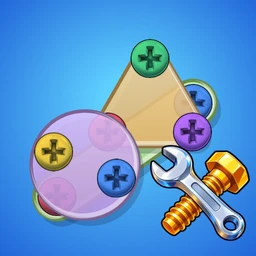
Bolt Buster puts a stack of colorful plates in front of you, each held down by screws. Tap a screw and it spins out and flies to a toolbox of the same color. Pull every screw from a plate and the plate drops away, revealing what was underneath. Clear every screw on the board and you win.
The catch is the toolboxes. Only two are open at a time, each holds three screws, and any screw without a matching open box goes to a tiny spare tray. Overfill that tray and the level is over. So every tap is really a question of timing.
The rules
- Tap to unscrew. You can only remove a screw that isn't covered by a higher plate that's still fastened. Tapping a covered screw shows "Blocked!" and outlines the plate in the way in red.
- Screws sort themselves. If an open toolbox of that color has room, the screw goes there. Otherwise it drops into the spare tray.
- Boxes rotate. When a box gets its third screw, it's marked done and flies away, and the next box from the queue slides in. The NEXT panel shows the colors of the next three boxes.
- The tray empties itself. When a new box arrives, any screws of its color waiting in the tray jump into it automatically.
- Plates fall. A plate with no screws left drops off the board. A plate down to its last screw wobbles to let you know.
The level fails the moment a screw arrives at a full spare tray. On most levels the tray has only one hole, and only a few levels give you more.
Beginner strategy
- Bank matching screws first. If an uncovered screw matches an open box, taking it is never a mistake. It costs no tray space and moves a box toward completion.
- Check NEXT before using the tray. If a screw has to go to the tray, prefer a color that's coming up soon in the queue. It will be collected as soon as that box arrives.
- Count by threes. Each box takes exactly three screws. When a box has two screws, look for its third one before you start anything else.
- Look underneath. Before freeing a plate, think about what it's covering. Dropping a plate can uncover exactly the screws your open boxes need.
Advanced techniques
The top plate isn't always first
It's tempting to work from the top of the stack down, finishing whichever plate has the fewest screws left. From level 3 onward, the tray size is set so that this obvious approach overflows, while a smarter order fits. The level 5 banner says it directly: "The top plate isn't always first." Sometimes the right move is to take a single matching screw from a lower plate and leave the top plate for later.
Plan two boxes ahead
Because the tray is so small, you can usually afford only one off-color screw at a time. Before you send a screw to the tray, check that the box which will clear it is either open or next in line, and that you can fill the box in front of it without needing a second tray slot. Working through two boxes ahead is usually enough to see a dead end coming.
Deal with rusty bolts
Rusty bolts appear at level 6. A rusty bolt shows a number, which is how many more screws you have to remove elsewhere before it loosens. Tapping it early gives "Rusty!" and a count. Treat a rusty bolt as a timer. If its color is in an open box now, make sure enough other screws come out first so it's free before that box needs it.
Read through glass
From level 13, some plates are made of glass, so you can see the screws beneath them. Use that to plan which plate to free next, because you know in advance which colors it will uncover.
Undo to explore
Undo is unlimited, and it reverses taps one at a time, even bringing fallen plates back. If a line of play leaves you one tray slot short, step back to the last decision and try the other screw.
Common mistakes
- Filling the tray with a color that's far away in the queue. That slot stays blocked for a long time.
- Racing to drop plates. A falling plate feels like progress, but if it uncovers colors you can't place yet, it can force a tray overflow.
- Forgetting rust counts. A rusty bolt you need right now is a problem. Count ahead.
What changes in later levels
The first five levels each add one idea: tapping, falling plates, the spare tray, the NEXT queue, and the fact that the top plate isn't always first. Rusty bolts follow at level 6, and level 10 is the first big board. Glass plates join at level 13. After that, levels follow a pattern within each set of ten: the first couple are relaxed, the middle ones are medium, the later ones are hard, and every tenth level is a large boss board with extra rusty bolts. Stacks grow taller and use more colors as you progress.
FAQ
What does the hint show?
It highlights the next screw to tap on a path that clears the board from your current position. If no path exists, it tells you to tap undo.
Why did "Stuck? Tap UNDO or HINT" appear?
Your tray isn't full yet, but the game has worked out that no order of taps from here clears the board. Undo a few moves.
What does continue do after an overflow?
It drills one extra hole in the spare tray and lets you carry on from where you were.
Can I skip a level?
Yes. If you enjoy color sorting with a different twist, try Nut Sort or Water Sort.