 Happy Life Games
Carrom Master Guide: Aiming, Power, Cushion Banks and the Queen
Carrom is a tabletop game that's popular across South Asia: you flick a heavy striker disc across a smooth square board to knock coins into the four corner pockets. Carrom Master turns it into a puzzle. There's no opponent and no score race. Each level sets out a few coins, sometimes with fixed brass posts in the way, and gives you a limited number of shots to pocket every one.
That shot limit is what makes it a puzzle. You can't just bash away until something drops. You have to pick the right pocket, the right spot on the baseline and the right amount of power.
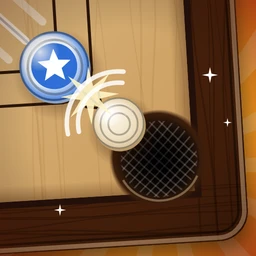
How to play
Every shot has two parts:
- Place the striker. Drag the striker along the slider below the board (or drag along the baseline itself) to move it left or right. It can't sit on top of a coin. If you try to shoot from a spot that overlaps one, you'll see "Blocked!" and nothing happens.
- Pull back and release. Touch near the striker and drag backward, away from where you want it to go, like a slingshot. The further you pull, the harder the shot. A percentage and a colored ring show the power: green is soft, yellow is medium, red is hard. Let go to flick.
While you pull, a dotted line shows the striker's path up to the first thing it touches, with a ghost circle where it will make contact. When that first contact is a coin, a short yellow arrow shows which way the coin will be sent. If the path reaches a cushion first, a fainter second line shows the bounce.
Pocket every coin, including the red queen if there is one, and you win. The counter at the top shows your remaining shots and which coins are still on the board. Two things to watch:
- Fouls. If the striker itself drops into a pocket, it's a foul and you lose one extra shot on top of the one you just used.
- Brass posts are fixed in place. They never move and can't be pocketed. Coins and the striker simply bounce off them.
Run out of shots with coins left and the level ends with "Out of shots!"
Getting comfortable
Most early misses come from the wrong amount of power. Too soft and the coin stops just short of the pocket, which the game marks with "SO CLOSE!" Too hard and everything starts ricocheting off the cushions, often including the striker, which can roll into a pocket for a foul. For a coin that's already lined up with a pocket, a medium pull is usually plenty.
Use the yellow arrow as your main aiming tool. Slide the striker and adjust your pull until that arrow points straight into the pocket you want. If the arrow points beside the pocket, the coin will probably clip the cushion next to it and bounce away.
Also think about where the striker should come from. A straight hit, where the striker, the coin and the pocket are all in one line, is the most forgiving. Slide along the baseline to find a spot where the coin sits directly between you and the pocket.
Shots worth learning
Cut shots
When you can't line up a straight hit, strike the coin off-center. The coin travels along the line from the contact point through its own center, not in the direction the striker was moving. Thin cuts send the coin out at a sharp angle and need more power. The ghost circle and arrow show exactly where contact happens, so experiment by watching them, not by guessing.
The cushion bank
Sometimes a row of posts shields a coin from the baseline completely. The striker is too wide to slip between them. The way in is off a cushion: aim the striker at a side or top cushion so it rebounds into the coin from an angle the posts don't cover. The faint bounce line shows the first rebound, and the ghost circle on that line shows where it will hit.
Two coins in one shot
Some levels give you fewer shots than coins. That's a clear signal that at least one shot has to pocket two. Look for a pair sitting close together near a pocket mouth. A firm, straight hit on the first coin can push it into the second, and both drop in turn.
Choosing a different pocket
If a post sits right on the line between a coin and its nearest pocket, don't fight it. There are four pockets. A longer route to a clear pocket, or a cut toward a bottom pocket, is often easier than squeezing past a post.
Common mistakes
- Full power by default. Strong shots bounce around unpredictably and cause fouls. Use only what the shot needs.
- Ignoring where the striker ends up. After contact, the striker keeps moving. If its path heads toward a pocket, ease off or change the angle.
- Clearing the easy coins first. On levels with a tight shot count, the hard coin is the one to plan around. Sometimes an easy coin is in exactly the right spot to help you knock a harder one loose.
- Leaving the queen for last without a plan. If coins guard her, open the guard early so she has a path.
What later levels add
The first ten levels each introduce one idea, and some show a short tip before your first shot. Level 1 is one coin on a clear line, and level 2 adds a second. Level 3 brings in a brass post blocking the obvious line ("Posts never move. Try another pocket!"). Level 4 is the two-in-one shot. Level 6 shields a coin behind posts so you have to bank ("Blocked? Bank it off the cushion!"). Level 7 hides the red queen behind a ring of coins ("Free the red Queen!"). Levels 8 to 10 repeat these ideas with more coins and posts.
After that, levels mix everything. The pockets get a little tighter after level 10 and again after level 30, so shots that just barely dropped earlier can now catch the edge. The aim guide also gets shorter after level 30: the coin direction arrow and bounce preview disappear and the dotted line only runs a short way, so your eye has to do more of the work. Early levels give you one or two spare shots beyond the minimum. Later, most levels allow one spare, and some tenth levels give you none at all.
FAQ
What does the hint do?
It moves the striker to a good spot and shows the aim line with a hand demonstrating the pull. Follow the hand's direction and length.
Does pocketing the queen first matter?
No. In this game the queen is simply one more coin that has to go in. Order doesn't matter.
Can I undo a shot?
No, but the skip button lets you move past a level. For more aiming puzzles, try Mini Golf, which uses the same pull-back control, or Bowling Strike.