 Happy Life Games
Color Rings Guide: How to Sort Rings on Pegs, One Move at a Time
Color Rings is a sorting puzzle played with candy-colored donut rings stacked on wooden pegs. The rings start out mixed, and your goal is to rearrange them so that every peg holds just one color. The pegs and stacked rings may remind you of the Tower of Hanoi, but the rule that governs moves here is about color, not size, and that gives the puzzle its own character.
The most important thing to know before you start: you move one ring at a time. That small detail shapes almost every strategy below.
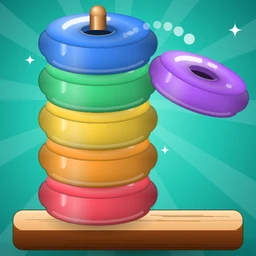
How to play
- Tap a peg to lift its top ring.
- Tap another peg to drop the ring there.
A ring can go onto a peg that is empty, or onto a peg whose top ring is the same color, as long as the peg isn't full. Each peg has a fixed capacity. In the first few levels a peg holds three rings, and from level 5 onward it holds four.
When a peg is filled to capacity with a single color, you'll see a cheerful "Nice!" above it. The level is won when every peg is either a complete single-color stack or empty.
There's no clock and no move counter to beat. If you reach a position with no way forward, a banner reminds you that undo and hints are there.
Why one ring at a time matters
In many sorting games, a group of matching pieces moves together in a single action. Here, three blue rings at the top of a peg take three separate moves to relocate, and the destination needs three free spaces. That has two big consequences:
- Moving a group costs space as well as moves. Before you start moving a run of matching rings, make sure the target can take all of them. Otherwise you'll end up with the color split across two pegs.
- You can split groups freely. Since each ring moves on its own, you can peel off exactly one ring from a group whenever that's useful. This gives you fine control that other sorting games don't.
Beginner strategy
The empty peg is your workspace. Most levels give you just one empty peg's worth of room. Sometimes that's an actual empty peg, and sometimes it's gaps spread over several partly filled pegs.
- Prefer matching moves. Placing a ring on the same color uses a free slot that's already part of a growing stack.
- Finish pegs when you can. A completed peg is a solved part of the board you no longer have to think about.
- Use the empty peg as a temporary parking spot, and only for a color that has other rings close to the surface ready to join it.
- Read the ring underneath. Every move reveals the next ring down. Ask whether that ring has a home before you lift the one above it.
Advanced techniques
Choose a target color
Count where all the rings of each color are. Every color has exactly as many rings as a peg holds, so a color is solved when all its rings are on one peg. The color whose rings are closest to the tops is the cheapest to finish. Starting with it frees up space for the harder colors.
Build on a single-color base
A peg that holds only one color, even if it's not full, is a perfect collection point. Keep feeding it and don't cover it with other colors. If you have two such pegs of the same color, merge the smaller one into the larger one to free a peg.
Don't trust the first obvious move
From level 3 onward, our puzzles are selected so that the most natural-looking opening isn't the best one. Often it's a move onto a matching ring or onto a single-color stack. In many levels that tempting move actually leads to a position that can't be finished. Treat your opening with extra care. Look at two or three candidate moves and play out each one in your head.
Count free slots before moving a run
Say the top of a peg has two orange rings and you want them on another orange peg. Count the free slots on that peg first. If there's room for only one, moving both isn't possible, and the second orange ring needs another home. Thinking about capacity first saves a lot of undoing.
Work backward
Pick a peg you want to complete and imagine it one move from done. Which ring is still missing, and what's sitting on top of it? Unwind that chain back to your current position, and you have a plan.
Common mistakes
- Filling the empty peg too early. Once it's occupied, your ability to set rings aside drops sharply.
- Splitting a color by accident. Starting to move a run without room for the whole run leaves one color spread across two pegs.
- Covering a ring you need next. Dropping a ring on a peg buries whatever's underneath.
- Thinking like classic Tower of Hanoi. Ring size doesn't matter here. Only color and peg capacity do.
What changes in later levels
Level 1 is a one-move warm-up with two colors and the hint "Tap to move rings!" Levels 2 to 4 use small pegs that hold three rings, which keeps things readable while you learn. From level 5 the pegs hold four, and by level 8 or so you're sorting four colors. After level 10 most levels have four or five colors, and from around level 50 some have six.
The pace follows a sawtooth. Every tenth level is a peak, marked HARD LEVEL from level 20 onward, with more colors and a longer solution. The level right after a peak is a lighter one. Free space stays scarce throughout, about one empty peg's worth, so the planning habits above matter more as the color count rises.
FAQ
Is this the Tower of Hanoi?
It's inspired by the look of it. The classic Tower of Hanoi, published by the French mathematician Édouard Lucas in 1883, asks you to move a stack of different-sized disks without ever putting a larger disk on a smaller one. Color Rings swaps the size rule for a color rule. For the original puzzle and the elegant pattern behind its solution, read Tower of Hanoi Explained.
What does the hint show?
It shows the next move of a solution from your current position. If your current board can't be solved anymore, the hint first rewinds your moves until it can, and shows "Rewound!" so you know what happened.
How much can I undo?
As much as you like. Each tap of undo puts the last ring back where it came from, all the way to the start of the level.
What's a good next puzzle?
Try Nut Sort or Water Sort. They use the same matching rule, but a whole group of matching pieces moves in one go, which changes the rhythm of play.