 Happy Life Games
Save The Doge Guide: Where to Draw the Line to Stop the Bees
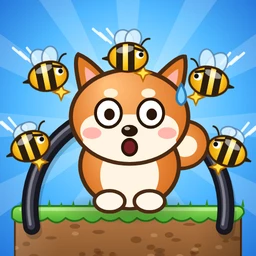
A dog sits on a rock ledge, happily unaware that a beehive is hanging overhead. You get one stroke of ink to protect it. Draw a line, lift your finger, and the line turns into a solid wall. The bees pour out and you watch the countdown. If no bee touches the doge in eight seconds, you win.
The fun of Save The Doge is that the line you'd draw on instinct, a big dome over the dog, stops working after the first few levels. The ink runs short and the terrain gets stranger. Soon the best wall isn't next to the doge at all.
The rules
- One line per attempt. Press, drag and release. As soon as you lift your finger, the line is fixed and the bees are released.
- Ink is limited. The meter at the top shows how much is left while you draw. When it runs out, the line ends right there, even if your finger is still moving.
- You can't draw through the doge. The line won't start on the dog and won't extend across it. A tiny tap or very short scribble doesn't count either; the game ignores it and lets you draw again.
- Survive the countdown. The timer counts down from 8. If any bee touches the doge before it hits zero, the doge gets stung and the level is lost.
Your line is a rigid wall. It doesn't fall or bend. The rock ledges and walls in the scene block bees in exactly the same way, so they're part of your defense too.
How the bees behave
Knowing what the swarm does is most of the puzzle:
- Bees leave each hive one after another over the first second or two, not all at once.
- Each bee heads straight for the doge, with a little random wobble.
- When a bee bumps into a wall, whether it's ink or rock, it crawls along the surface for a moment. That's how bees find their way around the ends of a line.
- Bees bounce off the edges of the screen and push away from each other, so a crowd spreads out along a wall.
Point 3 is the key. A wall with an open end is only safe if the path around that end is long or blocked. If the end is near the doge, the bees will slide along your line, come around the corner and sting.
Beginner strategy
On the first two levels the classic move works: draw an arch over the doge with both ends coming down to the ledge on either side. Ending the line on the rock is what makes it work, because it leaves no gap at the bottom for bees to crawl through.
Before you draw on any level, run through this checklist:
- Find every hive. Later levels can have two or three, sometimes on the sides as well as overhead.
- Look at the rock. Which directions are already blocked? Any side the rock covers is ink you don't need to spend.
- Find the openings. The real job is to close the gaps the bees can reach, not to wrap the dog.
- Check the ink. If a full dome would clearly need more ink than you have, look for a shorter answer.
Advanced techniques
Put a lid on it
From level 3 the doge often sits at the bottom of a well, between two rock walls. You don't need a dome. A straight line across the top of the well, from one wall to the other, seals it. Make sure each end actually lands on the rock. An end that stops short of the wall leaves a gap, and bees crawling along the line will find it.
Plug the gap
Level 5 introduces caves: a rock roof covers the doge, but one side is open. The tip says it well: "The roof already helps. Plug the gap!" Draw a short wall from the edge of the roof down to the ledge on the open side. On some caves the gap is diagonal. Draw from the tip of the roof down and outward to the ground.
Trap the bees at their hive
This is the big idea, and it shows up at level 7. Sometimes the hive hangs inside a little rock pocket that's open only at the bottom, while the doge sits fully exposed far below. There isn't enough ink to protect the dog, but there's plenty to close the pocket. One short line under the hive, from one wall of the pocket to the other, traps the whole swarm before it gets out. At level 12 a single pocket holds two hives, and one line closes both.
The choice levels
Every tenth level, starting with 10, is a choice level. The doge is in a wide well or a tall cave that you'd normally seal, but the lid would cost more ink than you have. Somewhere else on screen, a hive sits in a pocket. The quiet answer is to ignore the doge and trap the hive. When the obvious defense looks just a bit too long, check whether the threat itself can be boxed in.
Leave a little margin
Your ink has some thickness, and a bee is a small circle, so a line that touches the rock at its very tip is usually fine. Ending a little past the edge of a wall, overlapping the rock, is safer than stopping exactly at it.
Common mistakes
- Drawing a flat cap above the dog. Bees reach the ends, crawl around and drop in from the side. The game is built so these "obvious" caps fail from level 3 on.
- Running out of ink halfway. Plan the line before you touch the screen, and draw it in one confident motion rather than a wiggly one. Wiggles use up ink.
- Forgetting a second hive. A wall that faces the main hive can leave the doge open to a hive on the side.
- Leaving a gap at the rock. Even a small opening is enough for crawling bees.
What changes in later levels
Each new idea gets a teaching level with a short tip: the well lid at 3, the cave plug at 5, the hive trap at 7, the choice at 10 and the twin-hive trap at 12. After that, levels cycle through those ideas in new layouts, and some add free-hanging hives alongside the main problem. Bees get more numerous and faster as you progress, and ink becomes tighter compared to the shortest winning line. On a hard level there's very little room for a long, curvy stroke.
FAQ
What does the hint do?
It shows a faint ghost of a winning line for a few seconds. Trace it in one stroke. If the bees are already flying, tapping the hint resets the level so you can draw again.
Can I erase my line?
Not once you've lifted your finger, since that's what releases the bees. If the run goes badly, you'll get another attempt after it ends. There's also a skip button if a level isn't clicking.
Why did a bee get through when my wall looked closed?
Usually one end of the line stopped just short of the rock, or the line curved back near the dog and left an opening the bees could crawl around.
What should I try next?
For another puzzle about controlling a physical scene, try Feed The Monster, where timing replaces drawing. Pin Pull has a similar "think before you release" feel.