 Happy Life Games
Bird Sort Strategy Guide: Group the Flocks and Clear the Tree
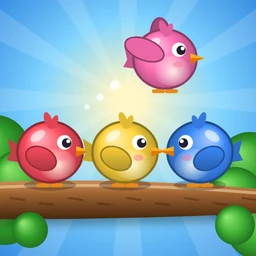
Bird Sort puts a sorting puzzle in a treetop. Colorful birds sit along branches that stick out from both sides of a trunk, all mixed up. Move them around until four birds of the same color share a branch, and that little flock takes off together. Clear every bird from the tree and the level is done.
It's a gentle game to look at, but the later trees are real puzzles. This guide covers the exact rules, the tactics that work, and what to expect as the flocks get bigger.
Rules and controls
Each branch has room for four birds. The bird at the outer tip of a branch, the end farthest from the trunk, is the one that can move.
- Tap a branch to select the birds at its tip.
- Tap another branch to send them there.
- Tap the same branch again to cancel.
Birds can land on a branch that is empty or whose tip bird is the same color, as long as there's room. If several birds of one color sit together at the tip, they all hop across as a group, or as many of them as the target branch has room for.
As soon as a branch holds four birds of one color, they fly away and the branch is empty again. A counter at the top of the screen shows how many flocks have flown out of the total. When the last flock leaves, you'll see "ALL FREE!" and the level is complete.
There's no timer and no way to fail. If you've run out of useful moves, or the position can no longer be solved, a banner suggests undo or a hint.
Why Bird Sort plays differently
Here's the key difference from water or nut sorting: a finished flock gives you its branch back. In most sorting games a completed column just sits there, full. In Bird Sort it empties out and becomes free space again.
That changes how you should think. Completing a flock isn't only progress toward the goal, it's also the best way to create room. Early in a level, when space is tight, the question is often not "which flock is easiest?" but "which flock can I finish soonest to get a free branch?"
Beginner strategy
- Look for three-plus-one. Three birds of one color on a branch with the fourth sitting at the tip of another branch is an instant flock. Grab it.
- Stack before you spread. Moving a bird onto a matching color costs no space. Moving it onto an empty branch uses up your best resource.
- Keep one branch as empty as possible. An empty branch lets you set aside a bird that's blocking something you need.
- Check what's underneath. Moving the tip birds reveals the next bird along the branch. Make sure that newly revealed bird has somewhere to go.
Advanced techniques
Count every color
Each color has exactly four birds. At the start of a level, find all four birds of a color and notice how far each sits from the tip. A color with all its birds near the tips is cheap to finish. One with a bird pressed against the trunk under three others is expensive. Finish the cheap flocks first, since each one hands you an empty branch for the hard ones.
Be suspicious of the easy-looking move
From the third level on, our trees are built so that the move that looks best at first glance, usually the biggest group landing on a matching color, isn't the best opening. In the early levels it just costs you extra moves. After level 10, it can lead into a position that can't be finished. Before your first move, look for a quieter alternative and compare.
Split groups on purpose
Because birds move only as far as there's room, you can split a group deliberately. If a branch has two red birds at the tip and another branch has two reds with space for two, all of them combine into a flock. But if that target only has room for one, one red goes across and one stays. Sometimes that's exactly what you want, for example when the single red completes a flock and the leftover can wait.
Plan a flock backward
Choose the flock you want next and picture the moment just before it flies: three birds on a branch and one more at a tip nearby. What needs to move for that to happen? Working back two or three steps tells you the right order of moves far better than trial and error.
Common mistakes
- Filling the empty branch with a lone bird. A single bird parked on an empty branch blocks every other color from using it.
- Delaying easy flocks. A flock you could finish now is free space you're choosing not to have.
- Covering a needed bird. Landing birds on a branch hides the bird underneath. If you need that bird soon, land somewhere else.
- Undoing only one move when stuck. The real mistake is often three or four moves back. Rewind further and try another line.
What changes in later levels
Level 1 is a short tutorial with two colors and a pointing hand. The next few levels add a third and then a fourth color. Early on, birds of the same color are often dealt in pairs, which makes the trees friendlier. Later trees deal birds more individually and look more scattered.
Difficulty rises in a sawtooth. Level 10 and every tenth level after it is a peak marked HARD next to the flock counter, and the level after each peak eases off. From level 20 onward, those peak levels can have six or seven colors.
Free space changes shape as well. Some trees start with every branch full except one empty branch. Others spread the same few empty perches across several branches, so no branch starts empty at all. On those, your first goal is to finish a flock as fast as possible to get a clean branch. A few of the hardest trees get one extra branch's worth of perches, because without it they couldn't be solved.
FAQ
What does the hint do?
The hint highlights two branches and shows a hand moving birds from one to the other. That's the next move of a solution from where you are now. If your current tree can't be solved anymore, the hint first rewinds your moves to a solvable spot and tells you it did so.
Can I undo as much as I like?
Yes. Undo steps back one move at a time, all the way to the start of the level if you want, including bringing back a flock that already flew away.
Does it matter which side of the tree a branch is on?
No. Branches on the left and right work the same way, and you can move birds between any two branches.
What should I play next?
If you like Bird Sort, Water Sort uses the same move-onto-a-match rule, but finished tubes stay full. That makes an interesting contrast. Nut Sort is another close cousin.