 Happy Life Games
Brick Breaker Guide: Aiming Volleys, Gaps, Steel, Bombs and Lasers
Our Brick Breaker is not the paddle game from the arcade era. It is an aiming puzzle: you fire a whole stream of balls at one angle, watch them ricochet around a grid of numbered bricks, and try to clear the board within a small number of shots. Every level is a hand-built layout with one idea at its heart, and from the third level on, the shot that looks obvious is usually not the one that wins.
That is what makes it satisfying. When you find the angle that sends twenty balls rattling behind a wall of bricks, the board melts in a single volley.
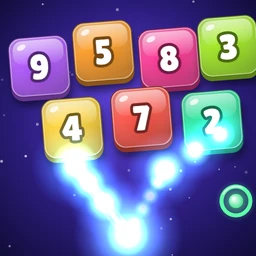
How a turn works
- Drag to aim. Put your finger down and drag above the launcher at the bottom of the field. A dotted line traces the path of the first ball through its first two bounces. If you drag too low, the aim cancels.
- Release to fire. Every ball you own leaves the launcher one after another along the same line.
- Each hit removes one point. The number on a brick is how many hits it still needs. Balls bounce off the side walls, the ceiling and the bricks themselves until they drop back to the floor.
- The board steps down. When the last ball lands, every brick moves down one row. The launcher also moves to the spot where your first ball landed, so your next shot starts from there.
The pips in the top-right corner are your shot budget. You win the moment every breakable brick is gone, and the game tells you how many shots you had to spare. You lose if you run out of shots with bricks still standing, or if a breakable brick is pushed past the bottom row. A DANGER! warning appears when bricks reach the last row, and LAST SHOT! appears when one pip remains.
Long volleys speed themselves up after a few seconds, so you are never stuck waiting. There is no undo. The hint button draws a winning shot from your current position in yellow, and if no winning line is left it says so and suggests restarting. A skip button is also available.
Beginner strategy
The budget is tight on purpose. It is set from the fewest shots that can clear each layout, with one extra shot only on the first two levels. So treat every volley as a plan, not a test.
- Read the numbers first. Add up the big bricks. If one brick needs more hits than you have balls, a straight shot can't kill it in one go. You need balls that hit it many times, which means trapping them near it.
- Watch where the first ball lands. That sets the launcher position for the next turn. A first ball that comes down on the far side can open or ruin your follow-up angle.
- Collect the green +1 rings. A ring adds one ball, and the extra ball stays for every shot after that. Grabbing rings early makes later volleys stronger.
Advanced techniques
Get the balls above the bricks
This is the single most important idea in the game. A ball that reaches the space between the bricks and the ceiling bounces back and forth up there, hitting the tops of bricks again and again before it can escape. Many early levels put a row of bricks across the field with one empty column. Firing straight at the nearest brick wastes the volley. Aiming the stream through the gap lets every ball pile damage onto the tough bricks hidden behind it.
Bank shots
The dotted line shows two contacts, which is enough to plan a bounce off a side wall. Some levels tuck a cluster of bricks into a corner pocket under a shelf of steel. You can't reach it directly, but a ball that hits the opposite wall at the right angle comes back in underneath the shelf. Move your finger slowly and watch where the second segment of the guide ends.
Steel
Grey steel blocks never break and don't need to be cleared. Balls simply bounce off them. That makes steel a wall to route around, but also a backboard: a steel slab behind a brick sends balls back into it for extra hits.
Bombs
A bomb brick has a number like any other. When it finally breaks, it destroys all eight bricks around it no matter how many hits they had left, and if another bomb is in the blast, that one goes off too. Steel survives the blast. On bomb levels the high-numbered bricks are usually packed around the bomb, so focus fire on the bomb itself instead of chipping at its neighbors.
Lasers
A laser pickup sits in a gap in a row of bricks. Every ball that passes through it zaps the whole row for one point. Since each ball triggers it separately, a volley of ten balls flowing through the laser deals ten damage to every brick in that row. The laser is used up after that volley, so send your full stream through it on the first try.
Rings first, smash later
Some levels start you with very few balls next to a lane of rings. A volley that collects the rings does little damage now but multiplies your next shot. When your ball count looks too small for the bricks, that is the signal to spend a shot on rings.
Common mistakes
- Shooting at the closest brick. From level 3 onward the levels are checked so that this shot does not lead to a win.
- Ignoring the landing spot. A great volley that leaves the launcher in a corner can make the next gap impossible to reach.
- Wasting the laser or bomb. Both reward one decisive volley. Half-committing spends a shot for little gain.
- Forgetting the step down. The board moves one row closer after every shot, and that changes your angles.
What changes in later levels
The opening levels introduce one element each: aiming in level 1, the +1 ring in level 2, gaps in levels 3 and 4, steel in level 5, rings-first in level 6, bombs in level 7, bank shots in level 8 and lasers in level 12. New elements show a short tip with a NEW! badge. Your ball count grows as you go, from a handful early on to many more in later levels.
After that, levels cycle through these ideas with a sawtooth rhythm. Every tenth level is a peak that layers two ideas together, such as a bomb behind a steel gap, and the level right after a peak is an easier breather. Peaks have fewer winning angles, so take your time aiming.
FAQ
Do steel blocks count toward clearing the level?
No. Only breakable bricks count. Steel can stay on the board when you win, and steel reaching the bottom does not end the game.
Do the +1 balls last?
Yes. A collected ring adds a ball starting from your next shot and keeps it for the rest of the level.
Why did my hint say I'm stuck?
The hint searches for a winning sequence within your remaining shots. If an earlier shot made the level unwinnable, there isn't one, so restart and try the hinted first shot.
Is there a similar game with a different feel?
If you like planning bounces, try Ricochet Shot. For aiming at colored clusters, Bubble Shooter is a good next stop, and our guide on thinking about physics puzzles covers the general habits.