 Happy Life Games
Color Link Strategy: How to Connect Every Pair and Fill the Board
Color Link gives you a square board scattered with pairs of glowing gems. Your job is to join each pair with a pipe of its own color. Pipes can bend as much as you like, but they can't cross each other, and when you're done, every single cell on the board has to be covered by a pipe.
That last rule is what makes the puzzle. Connecting the pairs is usually easy. Connecting them so nothing is left empty means at least one pipe has to wander the long way around, and figuring out which one is where the fun is.
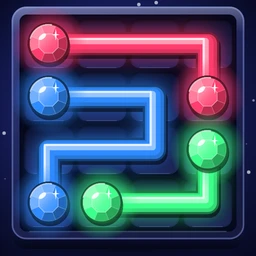
How to play
- Drag from a gem to draw a pipe. The pipe follows your finger or mouse one cell at a time, moving up, down, left or right.
- Finish on the matching gem. When the pipe reaches the other gem of its color, that pair is connected.
- You can't pass through other gems. A pipe can only end on its own color.
- Drawing over another pipe cuts it. If you drag through a cell another color is using, that pipe is trimmed back to just before the crossing. You'll need to redraw it later.
- Fix a pipe by redrawing it. Start a new drag from either of its gems to draw it fresh, or touch any cell in the middle of a pipe to keep the part up to that cell and continue from there. Dragging back along your own pipe also shortens it.
- Win when every pair is connected and every cell is filled.
The bar above the board shows how many pipes are complete and what percentage of the board is filled. If all pairs are linked but some cells are empty, the game reminds you to fill every cell. The bottom bar has restart, hint and skip buttons. There's no undo button, but since any pipe can be redrawn by dragging from its gem, you don't really need one.
Beginner strategy
- Connect neighbors first. Two gems of the same color sitting side by side, or with one cell between them along an edge, are usually joined directly. Draw those and they're out of the way.
- Work the edges and corners. A gem in a corner has only two ways out. A pipe running along the border has fewer choices than one in the middle, so edges are where the board's shape is most fixed.
- Trace the outer ring. Often one pair has gems near opposite ends of an edge, and its pipe runs along the border between them. Look for that before drawing anything through the middle.
- Leave the middle for last. Once the edges are settled, the remaining space is smaller and the routes become obvious.
Advanced techniques
Find the pipe that takes the long way
From level 3 on, a tip reminds you that the shortest line isn't always right. Every board has exactly one solution, and in most of them a pair of gems that sit close together is joined by a pipe that winds far across the board. When you have empty cells left over at the end, ask: which pipe could be stretched to pass through them without blocking anyone else? That pipe is usually the long one.
Look for empty pockets
A pocket of empty cells surrounded by pipes and walls can only be filled by a pipe that enters and leaves it. If a pocket is touched by just one pipe, that pipe has to detour through it. If it's touched by none, a pipe somewhere is drawn wrong.
Avoid stranding a gem
Before you draw a long pipe, check that it doesn't wall off another pair. If one gem of a color ends up on one side of your pipe and its twin on the other, the board can't be solved. A quick look along the full length of your planned route prevents a lot of redrawing.
Avoid 2x2 bends of one color
Since each board has a single solution, a pipe almost never doubles back on itself to fill a little square of four cells. If your pipe is forming a tight U-turn in open space, there's probably a better route where that pipe runs straighter and another color fills the gap.
Use the hint wisely
The hint plays a short animation of one pipe's correct route. It picks a pipe you've drawn wrong if there is one, and otherwise the trickiest unfinished pipe, the one with the longest detour. Often that one reveal is enough to make the rest fall into place.
Common mistakes
- Drawing every pipe as short as possible. That connects all the pairs and leaves holes. On this game's boards, a short pipe that leaves empty cells is almost always wrong.
- Accidentally cutting a finished pipe. Dragging through another color trims it. If a completed pipe suddenly loses its connection, that's what happened.
- Starting in the middle. Pipes drawn through the center early tend to split the board. Edges first.
- Restarting the whole board. Usually just one or two pipes are wrong. Redraw those instead.
What changes in later levels
The first level is a three-by-three tutorial with two pairs. Level 2 is a four-by-four warm-up. Levels 3 through 9 use five-by-five boards, each with a small detour idea, and the boards grow to six-by-six at level 10, seven-by-seven around level 20, and eight-by-eight from about level 35. Larger boards carry more pairs, up to eleven colors on the biggest grids.
Difficulty rises in a sawtooth. Every tenth level is a boss board, marked with a flame in the status bar, built to have the most winding solution. The level right after each boss is lighter, with fewer detours.
FAQ
Can pipes cross or share a cell?
No. Each cell holds at most one pipe. Drawing into a cell already used by another color cuts that other pipe back.
I connected every pair, so why didn't the level end?
Some cells are still empty. Check the fill percentage at the top. At least one pipe needs to take a longer route to cover the gaps.
Is there more than one solution?
Each board is checked by a solver to have exactly one way to fill the whole grid. If you've filled it, you've found it.
How do I erase a pipe?
Start dragging from one of its gems. The old pipe disappears and you draw it again from scratch. Touching a cell in the middle of a pipe keeps only the part up to that cell.