 Happy Life Games
One Stroke Paint Guide: How to Cover Every Cell in a Single Line
One Stroke Paint hands you a paint roller and an unpainted shape made of square cells. Starting from the marked cell, you drag the roller through the shape and try to paint every cell in one continuous stroke, never rolling over a painted cell twice. Small boards take seconds. Bigger ones, with notches and narrow arms, reward a bit of planning.
The puzzle is pleasant because you can feel your way through it. Each stroke is visible, mistakes are easy to back out of, and the last few cells are always satisfying to fill.
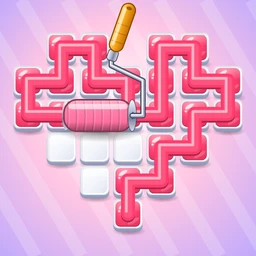
How to play
- Drag from the start cell. The roller begins on the marked cell. Move your finger or mouse into a neighboring cell (up, down, left or right) to paint it. Diagonal moves don't count.
- Keep going until every cell in the shape is painted. A counter under the board shows how many cells you've painted out of the total.
- You can't cross your own paint. Moving into an already-painted cell that isn't the one you just came from does nothing except a small shake.
- Back up by dragging backward. Slide back onto the cell you just left and the last step is erased. You can also tap any painted cell on your stroke to cut the stroke back to that point.
- Buttons: undo removes the last painted cell, restart clears the board, hint draws the next few steps of a working route, and skip moves on to the next level.
There's no time limit and no way to lose. If your stroke reaches a cell with no unpainted neighbors, you get a "Dead end!" message. If the game can tell your stroke can no longer cover everything, even before you're physically stuck, it says so with a gentle "Stuck? Undo or hint".
Beginner strategy
Most early mistakes come from leaving a corner or a narrow arm behind and then having no way back to it. A few habits fix that:
- Look at the whole shape first. Find the corners, the one-cell-wide arms and any cell touched by only one or two others.
- Clear the hard parts while you can reach them. A thin arm is like a hallway: you go in and you have to come back out, unless it's where your stroke ends. Paint it early, when there's still space behind you.
- Hug the edges. Running along the outside of the shape and spiraling inward tends to leave the open middle for last, where it's easy to finish.
- Don't just keep going straight. From level 3, the boards are designed so that rolling straight until you hit a wall and then turning fails. Look one or two moves ahead at each turn.
Advanced techniques
Find the forced end
Count how many unpainted neighbors each unpainted cell has. A cell with only one unpainted neighbor is a dead-end cell: if you enter it, you can't leave. So that cell has to be the very last cell of your stroke. If you ever see two such cells at once (not counting the one next to your roller), the stroke can't be finished, and it's time to back up.
This works in reverse, too. Once you know where the stroke must end, you can plan your route so you arrive there last instead of hoping for the best.
The checkerboard trick
Imagine the grid colored like a chessboard. Every move goes from a light cell to a dark one or back, so your stroke alternates colors. If the shape has one more light cell than dark cells, the stroke must start and end on light cells. If the counts are equal, it starts on one color and ends on the other. Since the start is fixed, this tells you which color your final cell is, which narrows down where the stroke can finish. It also explains why some tempting routes can never work, no matter how carefully you draw them.
Don't cut the shape in two
Painted cells act like walls. If your stroke slices across a shape and leaves unpainted cells on both sides, you can only ever reach one side again. Before crossing a narrow neck in the shape, make sure everything on the far side can be painted in one pass, or everything on the near side is already done.
Rewind to the decision, not to the start
When you're stuck, think about where you went wrong instead of restarting. Usually it was one specific turn: entering a region too early, or skipping a corner. Tap the painted cell just before that turn. The stroke cuts back to that point and you can try the other direction without redoing everything else.
Common mistakes
- Leaving single cells behind. A lone unpainted cell beside your path is almost always a dead-end cell in the making. Deal with it before moving away.
- Restarting too often. Restart throws away good work. Dragging back or tapping a painted cell is quicker.
- Moving too fast through tight spots. Quick drags paint every cell you pass through, so a careless diagonal swipe can paint a cell you didn't mean to. Slow down near corners.
- Trusting the first route that looks right. The first move out of the start cell is often the trap. If several directions are possible, ask which one keeps the most options open.
What changes in later levels
The first levels are tiny strips of three to five cells meant to show the controls. By level 10 the board is five by four, and from there shapes grow to six or seven cells wide and up to nine rows tall. Shapes become more irregular as they grow, with more missing squares, notches and narrow passages that create dead-end cells.
The levels are chosen to have very few working routes from the given start, and in most of them the majority of first moves fail. Every tenth level is a larger peak board, followed by an easier one. On the biggest boards, finishing earns a "MASTERPIECE!" banner instead of the usual "PERFECT!".
FAQ
Can I start from any cell?
No. The stroke always begins at the marked start cell. Choosing where to finish is up to you, and the end-cell reasoning above is the best way to decide.
Is this the same as the classic "draw this figure without lifting your pen" puzzle?
Not quite. The classic version asks you to trace every line once, which is an Euler path problem. Here you visit every cell once, which mathematicians call a Hamiltonian path. Our article on one-stroke puzzles and Euler paths explains the difference.
What does the hint do if my stroke is already wrong?
If your stroke can still be completed, the hint shows the next few steps from where you are. If it can't, the hint cuts your stroke back to the last point that matches a working solution, then shows the way forward from there.
Is every level solvable?
Yes. Every board is checked by a solver to make sure at least one complete stroke exists from the marked start.