 Happy Life Games
Marble Zuma Guide: Aiming, Combos, Gems, Stones and Power Marbles
A line of colored marbles creeps along a carved spiral, and at the end of the track a skull waits with its mouth open. You stand in the middle as a stone idol, firing marbles into the chain. Three or more of the same color touching pop, the gap closes, and if the colors on both sides of the gap match, the chain snaps back together and pops again. Marble Zuma is about setting up those chain reactions while the line keeps rolling.
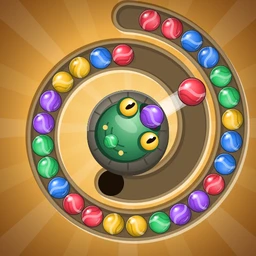
Controls and rules
- Aim by touching the board. The idol turns toward your finger and a dotted line in the marble's color shows where the shot will go, stopping at the first marble in its path.
- Release to fire. The marble flies along that line and slots into the chain. It goes in on whichever side of the marble you hit it lands, front or back.
- Tap the idol to swap. The idol shows your current marble and the next one. Tapping it switches them.
- Pop three or more. A run of three or more matching marbles disappears.
Only one marble can be in the air at a time, and you can't fire during the quick roll-out at the start of each level. The colors you're given always come from marbles still on the track, so you never hold a color that has nowhere to go. A shot that misses the chain just flies away.
You clear the level by removing every marble. You lose if the front of the chain rolls into the skull. As it gets close, the skull lights up and a ticking sound starts.
Each win earns up to three stars. One is for clearing the chain. A second is for saving every gem on gem levels, or for keeping the chain away from the glowing zone near the skull on other levels. The third is for making at least one chain-reaction combo. The hint button shows a recommended shot with a dotted line, or tells you to tap the idol when the better shot uses your next marble. There's also a skip button.
How the chain moves
The track works like a conveyor pushing from the back. When marbles pop, the chain splits. The rear part keeps rolling forward. The front part stops, unless the two marbles facing each other across the gap share a color. In that case the front part rolls backward to meet the rear, and when they touch, that run is checked again. If it now has three or more, it pops as a COMBO, and the process can repeat.
This is the heart of the game. A shot that pops three marbles is fine. A shot that pops three marbles and pulls two matching ends together is far better, because it removes more of the chain and pulls the front back toward safety.
Beginner strategy
- Look for pairs. The chain is built with plenty of two-in-a-row pairs and no ready-made triples. Any pair is one shot from popping.
- Check both marbles before shooting. If your current color has no pair to hit but the next one does, tap the idol and swap.
- Work the front first. The marbles closest to the skull are the ones that can lose you the level. Popping near the front also stops that part of the chain while the rear catches up.
- Avoid feeding singles into the wrong place. If no pair is available, drop the marble next to its own color to create a new pair instead of splitting two matching marbles apart.
Advanced techniques
Build sandwiches
Look for patterns like red, blue, blue, red. Pop the blue pair and the reds on each side meet. If one side is already a pair, the meeting makes three and pops automatically. Spotting these before you fire is how you get combo stars.
Mind the insertion side
A marble that hits slightly in front of a target slides in ahead of it, and one that hits slightly behind slides in after it. When you aim at the seam between two marbles, a small adjustment decides which pair your marble joins.
Gems
Gem marbles sit in the front part of the chain. Pop a gem as part of a match before it rolls into the glowing zone near the skull, or it turns dull and is lost. Losing a gem doesn't end the level, but it costs the gem star. Prioritize matches that include gems while they're still far from the glow.
Stones
Grey stones never match. They crack only when a marble right next to them pops. Stones are placed in a set pattern: two of one color, a pair of another color, the stone, then the first color again. Pop the pair beside the stone, the stone cracks, and the two matching ends snap together for a combo. If only stones are left on the track, they crumble on their own.
Power marbles
Power marbles sit on a pair, so one more matching marble sets them off.
- Bomb: also blasts two marbles on each side of the pop.
- Reverse arrow: pushes the whole chain back down the track. Save it for when the front is getting close to the skull.
- Hourglass: slows the chain to a crawl for about six seconds, which gives you time to line up careful shots.
Common mistakes
- Chasing the back of the chain. Clearing marbles near the entrance looks productive, but the front keeps creeping toward the skull.
- Breaking up pairs. Firing a mismatched marble between two matching ones costs you an easy pop.
- Using the reverse arrow too early. Its push back is most valuable when you are actually in danger.
- Forgetting the swap. Many "bad" marbles are fine once you look at the next one.
What changes in later levels
Each early level is built around one named idea. Level 1 is a tiny six-marble chain, and level 2 teaches making triples. Gems arrive in level 3, bombs in level 5, stones in level 7, the reverse arrow in level 9 and the hourglass in level 11. Level 10 mixes stones, a bomb, a reverse arrow and gems. When a new element appears, a banner explains it.
The track shape changes too: round spirals, squarish spirals, wavy ovals and flower-like serpentine paths. The chain gets longer and faster as you progress. Levels 1 to 10 use three colors, levels 11 to 30 use four, and after that there are five. Most later levels combine two elements. Every tenth level after level 10 is a boss with three elements and a longer, quicker chain, and the level after it eases off with just one.
FAQ
Is there a time limit?
No clock, but the chain never stops rolling. The real limit is how far the front is from the skull.
Can I shoot more than one marble at once?
No. You have to wait for the current marble to land before firing again.
Do I lose if a gem reaches the glow?
No. You only lose that star. The level ends in failure only when the chain reaches the skull.
What else plays like this?
Bubble Shooter uses the same match-three aiming on a static board, and Candy Match is all about combos without the aiming.