 Happy Life Games
Paper Fold Puzzle Guide: How Creases, Flips and Fold Order Work
A sheet of paper sits on the table, divided into squares by dashed creases. Above it is a small card showing a picture. Fold the sheet the right way, in the right order, and the squares that end up on top form that exact picture. Fold it wrong and you get a jumble of mirrored pieces, upside-down halves and bits of a completely different image.
Paper Fold is a spatial puzzle more than a speed puzzle. Every level can be solved in a small, fixed number of folds, and the card tells you how many. The challenge is picturing what's printed on the back of the paper before you flip it over.
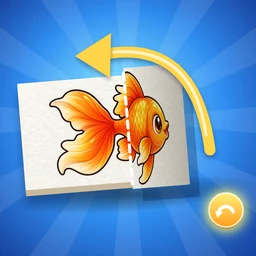
How to play
The sheet is a grid of square cells. Every crease you can fold right now is shown as an animated dashed line with a round arrow badge next to it. The arrow shows which way that flap will go.
- Tap a crease (or its badge, or the flap itself) to fold that side of the paper over onto the other side.
- Each crease folds in one fixed direction only. You choose which creases to fold and in what order, not which way they bend.
- A crease only appears when it can be folded: there must be paper on both sides, and the flap has to land fully on the sheet.
The text under the target card reads something like "Make this picture in 3 folds." That number is the length of the shortest solution. You win when the folded sheet covers exactly the picture's shape and every square on top shows the right piece, the right way up. A small "2/4 pieces" counter pops up whenever a fold puts another correct piece in place.
There's no timer and no move limit. Undo steps back one fold at a time and is unlimited. The hint makes the next correct crease glow and points a hand at it. If you've already folded yourself into a dead end, the hint points at the undo button instead. There's also a skip button if a level just won't click.
What a fold actually does
This is the part worth understanding before you play beyond the first few levels. When a flap folds over, three things happen to it at once:
- It flips face down. The side of the paper you couldn't see is now on top. The front of the sheet is cream-colored and the back is pale blue, which helps you track which side is showing.
- It mirrors. Folding over a vertical crease mirrors the flap left to right. Folding over a horizontal crease mirrors it top to bottom.
- It stacks in reverse. If the flap was already several layers thick, the layer that was on the bottom ends up on top.
Combine two folds and the effects add up. A square folded over one vertical and one horizontal crease is face up again, but rotated half a turn. A square folded twice over vertical creases is face up and the right way round. That's why order matters so much: the same set of folds done in a different order puts different faces on top.
Beginner strategy
Start every level by studying the target card, not the sheet. Note its shape. Is it one square, two side by side, two stacked, or a two-by-two block? The finished sheet must be exactly that shape, so the creases you need are the ones that shrink the paper toward it.
Next, look for target pieces already visible on the sheet. Many faces carry pieces of the target picture, but lots of them are traps: printed mirrored, upside down, or on a square that will end up hidden. A piece that looks correct right now only matters if nothing gets folded on top of it.
Then count. If the card says two folds and the sheet has three creases, one crease is a decoy that the solution never uses. Decoy creases first appear on level 2.
Advanced techniques
Ask what lands on top last
The final fold decides what's on top of the squares it covers. Work out which target squares the last flap will cover, then check whether the back of that flap carries the right pieces. If it doesn't, that crease can't be the last one.
Distrust the fold that looks best
From level 3 on, levels are chosen so that the fold that makes the sheet look most like the picture right away is not the start of the solution. It often reveals several target pieces at once, but in the wrong orientation or in places that get covered later. If one fold jumps out as obviously good, test it with undo before committing.
Track a single square
When the sheet gets big, follow one target square through the whole plan. Say the top-left piece of the picture has to end up face up and upright. Every fold that carries it flips it once. An odd number of flips leaves it face down, so it must be printed on the back of some other cell. Following one square usually rules out half the possible orders.
Use undo to read the back
Because undo is free and unlimited, folding a flap just to see what's printed underneath is a perfectly good move. Fold, look, undo. Two or three of these quick looks often tell you the whole solution.
Common mistakes
- Trusting a piece that's merely visible. A correct-looking face can be covered by a later fold.
- Ignoring orientation. The right piece upside down or mirrored doesn't count. The level only completes when every piece is upright.
- Folding every crease. Decoys exist. If the card says three folds, stop and rethink at three.
- Forgetting the final shape. If the folded sheet won't match the card's outline, no amount of reordering will fix it.
What changes in later levels
Level 1 is a single fold on a strip of three squares. The next levels add a decoy crease, then two folds where order matters, then two-row sheets. Level 7 brings the first three-fold puzzle. From level 12, some sheets have a corner cut off, which turns the rectangle into an L-shape and changes which creases can fold at all.
After that, sheets grow to three and four rows, solutions stretch to four and then five folds, and later levels can include two decoy creases. Difficulty runs in a sawtooth. Every tenth level from level 20 is marked HARD LEVEL, and the level right after it is lighter.
FAQ
Why can't I fold a crease I can see on the target?
A crease is only foldable when there's paper on both sides and the flap fits on the sheet. After some folds, a crease disappears because one side is already empty.
The picture is on top but the level didn't end. Why?
At least one piece is mirrored or upside down, or some paper sticks out beyond the picture's shape. Check each square against the card.
What does "Wrong order! Undo" mean?
No crease can be folded any more and the picture isn't finished. Undo a fold or two and try a different order. If the game says "Stuck? Undo or hint", you can still fold, but the current position can no longer reach the picture.
Are there similar puzzles?
If you like assembling a picture from parts, try Jigsaw Puzzle. For another puzzle where move order is everything, try Slide Puzzle.