 Happy Life Games
Portal Gun Guide: Two Shots, Blue In, Yellow Out
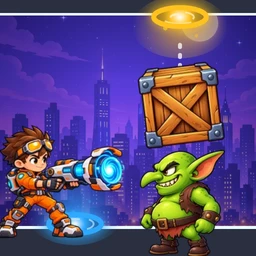
In Portal Gun you never touch the bad guys yourself. You stand on a ledge with a gun that opens two portals, and everything else is up to gravity. Drop a crate into the blue portal, let it fly out of the yellow one, and if you picked the right walls it lands on someone's head. Each level gives you exactly two shots, so the whole puzzle is choosing two spots on the wall before you pull the trigger.
It's a short game per level but a thinking-heavy one. This guide explains the rules our version actually uses, then walks through how to read a room and how to deal with the helmets, bombs, balloons and seesaws that show up later.
How a level works
Drag anywhere to aim. A dotted line runs from your gun to the wall it would hit. If that surface can hold a portal, a ghost portal appears at the end of the line. If it can't, you see a red X, and releasing there just shows the message "Glowing walls only!" without using up a shot. Release on a valid spot to fire.
- Shot one opens the blue portal. Blue swallows things. Any crate, ball, anvil or other loose object that moves into it disappears.
- Shot two opens the yellow portal. Yellow spits out whatever blue swallowed, pointing straight out of the wall it sits on, and the object keeps its speed. If several objects went in, they come out one at a time with a short gap between them.
- Only glowing faces take portals. Stone blocks have bright glowing edges on the sides that accept a portal. Dark metal blocks and unlit sides do not. You also can't put yellow on the exact spot where blue already is.
You win when every bad guy is knocked out. If both shots are used and the room settles down with anyone still standing, the level ends with "Missed!" Bad guys themselves never travel through portals, so the only way to reach them is with the objects in the room.
Three stars float along the path of a working solution. Objects that pass through them collect them. They're a bonus that hints at the intended route, not a requirement to win.
What actually knocks a bad guy out
Knowing the damage rules saves a lot of wasted attempts:
- A falling or flying crate, ball or anvil that hits a bad guy hard enough. A gentle bump does nothing, so height and speed matter.
- Landing on spikes, sinking into lava, or falling a long way onto the floor.
- A bomb blast. Bombs go off when they hit something hard, and the explosion takes out every bad guy nearby, shatters glass and sets off other bombs.
Two things never hurt anyone: glass boxes, which shatter harmlessly when they land hard, and balloons. And bad guys wearing a helmet shrug off everything lighter than an anvil. A crate hitting a helmet just goes "CLANG!"
A step-by-step way to plan
Because you only get two shots and there's no undo inside a level, it pays to plan before touching the screen.
- Pick the weapon. Find the bad guy and ask what can hurt him. Helmet? Only the anvil will do. Standing on glass above spikes? Breaking the glass might be enough.
- Find blue. Look for a glowing surface directly under that object (or, for a balloon, above it). If the object is resting on a glowing floor, a blue portal underneath makes it drop straight in.
- Find yellow. Now look for a glowing face that points toward the target. A portal on a ceiling shoots objects downward, one on a side wall shoots them sideways. Remember that whatever comes out keeps its speed, so something that fell a long way into blue comes out fast.
- Trace the path. Imagine the object leaving yellow. Does it clear the shelves? Does it land on the bad guy or bounce off something first?
Only after all four steps should you fire the first shot. Once blue is open, the object falls in and waits inside until yellow appears, so you have time to aim the second shot carefully.
Tactics for trickier rooms
The obvious pair usually fails
From level 3 onward, rooms are picked so that the most natural plan, blue under the nearest object and yellow right above the bad guy, doesn't work. Maybe the object is too light, maybe it lands short, maybe it hits a helmet. When the easy idea is right there, assume it's a trap and look at the other objects in the room.
Use speed, not just position
A crate that drops into a blue portal on a high shelf only picks up a little speed. A ball that has already rolled and fallen picks up more. Exits on side walls turn that speed into a long horizontal throw. If something keeps landing short, look for a way to make it fall further before it reaches blue.
Let the room do the work
Later rooms add machinery. Fans blow loose objects along the floor (bad guys brace and don't get pushed). A seesaw can fling whatever sits on the other end. A swinging log on a rope can sweep a bad guy off a ledge. A conveyor belt carries an object to the edge and drops it off. Lava destroys anything that touches it, including your crate, so keep exits away from lava pits. Often the right yellow portal isn't aimed at the bad guy at all. It drops something onto the machine, and the machine does the hit.
Bombs and balloons
A bomb doesn't need to land on anyone. It needs to hit something firmly near them. A bomb on a high shelf with two bad guys below is an invitation. Balloons float upward. One carrying an anvil drops its load when it touches spikes, which is how you get a heavy object over a helmeted target.
Common mistakes
- Firing blue without a plan for yellow. Once blue is open, there's no taking it back.
- Using a crate on a helmet. It never works. Find the anvil.
- Forgetting the exit direction. A yellow portal on a floor shoots things up, not down.
- Dropping glass on purpose. Glass breaks on impact and hurts nobody, unless breaking it is what lets someone fall.
What changes as you play
Levels 1 and 2 teach the two shots with a pointing hand. From level 3 to level 12, each level brings in one new element with a "NEW:" label: the anvil, glass, bomb, spikes, fan, seesaw, balloon, swinging log, lava and conveyor belt, roughly in that order. After that, levels mix these ideas, and every tenth level is a harder peak. As you go further, extra shelves with spare crates and glass boxes appear as decoys, so the room looks busier than the solution really is.
FAQ
What does the hint button do?
It shows ghost portals on the two spots of a working solution and a dotted line along the path the object takes. If you've already fired a shot that doesn't match, the level resets so you can follow the hint from the start.
Can I undo a shot?
No. Each level is two shots, and if they don't work you replay the level. The skip button is there if a room isn't clicking.
Why won't my shot fire?
You're aiming at a surface that can't hold a portal. Look for the glowing edges, or aim so the line ends on one. For another puzzle built on angles and walls, try Ricochet Shot, or read how to think about physics puzzles.