 Happy Life Games
Rope Twist Guide: How to Untangle Every Rope
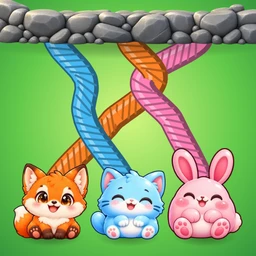
In Rope Twist, a row of ropes hangs from a rock beam at the top of the screen. At the bottom of each rope sits a small animal on a pedestal: a bunny, a fox, an owl, a frog and friends. The ropes are wound around each other in a messy braid, and your job is to move the animals between pedestals until every rope hangs straight and free.
It looks like a physics toy, but underneath it is a tidy logic puzzle with a single rule about twists. Once that rule clicks, you stop shuffling animals at random and start reading the braid like a set of instructions. This guide walks through the rule, the patterns that come up again and again, and how to handle the harder levels.
How to play
- Drag an animal sideways and drop it on an empty pedestal. There are always one or two more pedestals than animals, so there is always somewhere to go.
- While you carry it, the animal is lifted up and passes in front of the ropes of every animal it moves past.
- Each rope it passes gets one half-twist changed. Depending on the direction you travel, that either unwinds a twist the two ropes already had or adds a new one.
- When a rope has no twists left with any other rope, it flies away with its animal, and that pedestal opens up.
- Free every rope to win.
The best feature to know about is the live preview. While you drag, the ropes redraw to show exactly what will happen if you drop the animal right there, and any animal whose rope would come free bounces in place. Nothing is final until you let go, and dropping the animal back on its own pedestal cancels the move. So you can sweep an animal left and right and simply watch the braid before committing.
There is no move limit and no way to lose. Undo is free and takes back one move at a time. The hint button shows the next move with a hand dragging an animal to its target pedestal, and skip is there if you want to come back to a level later.
The twist rule, in plain terms
Think about any two ropes, say the fox's and the owl's. They may be twisted around each other zero, one, two or three times. When the fox is carried past the owl, that pair changes by exactly one half-twist. Carrying it past to the right changes the pair one way, and carrying it past to the left changes it the other way. If a move to the right adds a twist, a move to the left past the same rope removes one, and vice versa.
A second useful fact: compare the order of two animals at the bottom with the order of their anchors on the beam. If the animals are in the opposite order from their anchors, the pair has an odd number of twists, so at least one more crossing is needed. If they are in the same order but still visibly wrapped, they need an even number of crossings, usually two.
Beginner strategy
- Find the loneliest twist. Look for a rope that is wrapped around only one other rope. That animal is probably one or two moves from freedom.
- Drag slowly and watch. Move the animal toward an empty pedestal on one side and see whether the braid loosens or tightens. If it tightens, try the other side.
- Look for the bounce. A bouncing animal during a drag means that drop frees its rope. A drop that frees two ropes at once is usually a great move.
- Use the empty pedestals as a bench. An empty spot at the far end lets you carry an animal past several ropes in one move, which can fix several twists at the same time.
Advanced techniques
Count crossings, not ropes
A single move changes every rope between the start and end pedestals. That is powerful but also dangerous: a long move might unwind the twist you wanted while adding a new twist to a rope that was nearly done. Before a long drag, list the animals you will pass and ask what each pair needs. Sometimes a shorter move to a nearer empty pedestal is better, even if it takes an extra step later.
The leapfrog for double twists
Two ropes with two twists in the same direction can't be fixed by moving one animal back and forth, since crossing one way and then back cancels out. Instead, leapfrog them. Carry the first animal past the second in the direction that unwinds, then carry the second animal past the first in that same direction. Each pass removes one half-twist, and both animals end up having traveled the same way. Watch the preview to confirm which direction unwinds before you start.
Sometimes add a twist on purpose
Occasionally the quickest solution adds a twist to one pair so that a later move can clear two pairs at once. If every move you try seems to leave one stubborn rope behind, look for a move that tangles something briefly but lines up a big unwinding move next. Levels from 3 onward are built so that the move that clears the most twists right away is usually not the best opening.
Plan around freed pedestals
Every rope that flies away leaves an empty pedestal behind. Free the rope that will open up the most useful space first, often one in the middle, so the remaining animals have more places to land.
Common mistakes
- Dropping without looking at the preview. The braid tells you the result before you commit. Use it.
- Undoing a good move by reflex. Moving an animal back the way it came reverses its twist changes, so a back-and-forth pair of moves gets you nowhere.
- Chasing one rope. Fixing a single rope while tangling three others is a net loss. Keep an eye on the whole braid.
- Forgetting the far pedestals. Empty pedestals at the ends of the row allow long moves that pass many ropes at once.
What changes in later levels
The first two levels have just two animals and four pedestals, a gentle way to learn the rule. Three animals arrive at level 3, four at level 5 and five by level 8. Every tenth level is a peak marked "HARD LEVEL", and from level 40 those peaks use six animals on seven pedestals with solutions five or six moves long. The level after each peak eases off to three ropes so you can reset. As the rope count rises, pairs with two or three twists become common, so the leapfrog and the crossing count become everyday tools.
FAQ
Is there a limit on moves?
No. You can take as many moves as you like, and undo is free.
Why didn't a rope fly away when it looked straight?
It still has a twist with at least one other rope. A rope only leaves when every pair it belongs to is fully unwound.
Can I drop an animal onto an occupied pedestal?
No. Animals only land on empty pedestals. If you drop one on an occupied spot, it slides back to where it started.
How does the hint pick a move?
The hint shows the first move of a shortest solution from your current position, so following it is always safe.