 Happy Life Games
How to Solve Unblock Car Puzzles: Rules, Strategy and Tips
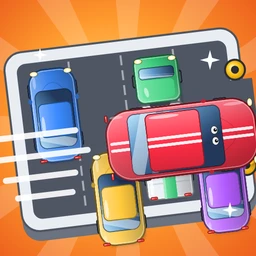
Unblock Car is a sliding block puzzle in the tradition of Rush Hour, the well-known puzzle designed by Nob Yoshigahara. A small square parking lot is packed with cars and trucks, and one bright red car needs to get out through the exit gate on the right. Nothing can be lifted or turned. Every vehicle can only slide back and forth along the direction it is facing, so the whole puzzle is about shuffling the right pieces out of the way in the right order.
What makes it satisfying is that the answer is usually hiding one or two steps back from where you are looking. The car in the red car's way is rarely the one you need to move first.
How to play
The lot is a 6 by 6 grid. The red car always sits on the third row from the top, facing right, and the exit gate is at the right end of that row.
- Drag a vehicle along its own direction. Cars lying left to right slide left and right; cars standing up and down slide up and down. You can slide a vehicle as far as the empty space allows in one drag, and that whole slide counts as one move.
- Vehicles can't pass through each other. If you drag into another vehicle or the wall, the car stops and the board gives a little shake.
- Win by getting the red car to the exit. When nothing is left between the red car and the gate, the lane lights up with "PATH CLEAR!" and you can drag the red car out or simply tap it to drive away.
Above the board you will see two numbers: MOVES, which counts your slides, and BEST, which is the fewest moves that solve this level. There is no fail state and no timer, so matching BEST is a personal challenge rather than a requirement.
The buttons under the board give you Undo (takes back one slide), Hint (highlights the vehicle to move, shows a ghost outline of where it should go, and points an arrow at it) and Skip. Hints are always calculated from your current position, so they still work after you have wandered off the best route.
Beginner strategy
The first two levels show you a hand that drags the right pieces, and they can be solved in one or two moves. After that the puzzles are built so the obvious first move is not the best one. A simple routine helps:
- List the blockers. Look along the red car's row toward the exit and note every vehicle sitting in it. In this game those blockers are always vertical, since the red car is the only horizontal vehicle in its row.
- For each blocker, ask where it can go. A vertical car in the red car's row has to move up or down far enough to clear that row completely. A two-cell car needs to move to rows that don't include row three; a three-cell truck usually has to go all the way to the top or the bottom.
- Find what is stopping that. If the space above and below a blocker is occupied, those vehicles become your new targets. Repeat the question for them.
- Start at the end of the chain. The vehicle you can move freely, that unlocks the next one, is your first move.
Advanced techniques
Count the cells, not just the cars
Before moving a blocker, count exactly how many empty cells it needs. A truck crossing the red row from rows two to four has to drop to rows four to six or rise to rows one to three, and only one of those is likely to be possible. Knowing the target position tells you which other vehicles have to shift first.
Make room on the far side
Many solutions involve moving a car away from where it seems useful. Sliding a horizontal car on the top row all the way to the left can open the column a truck needs to rise into. These "make room" moves look like they do nothing for the red car, which is exactly why they're easy to miss.
Move the red car backward
The red car can slide left as well as right. Occasionally a vertical car needs to come down through the red row to free something else, and that only works if the red car first backs out of the way.
Use undo to test a theory
When you can't see the chain, try a sequence of three or four slides and watch what opens up. If it leads nowhere, undo back to the start. Undo is free, and because MOVES drops by one for each undo, exploring doesn't spoil your count.
Common mistakes
- Pushing the nearest blocker first. From level 3 onward, the levels are chosen so that sliding the car directly in front of the red car is usually not the best opening.
- Half-moving a blocker. A two-cell car that still covers one cell of the red row is still a blocker. Make sure it clears the row completely.
- Parking trucks in the middle. A truck left in the center of a column blocks two rows at once. Push trucks to an edge whenever you can.
- Forgetting the red car can move. If you are stuck, check whether shifting the red car left would let something pass.
What changes in later levels
The lot stays 6 by 6 throughout, but it gets busier and the solutions get longer. Early puzzles use five to nine vehicles and need one to three moves. From level 6 the target length grows steadily, reaching around 11 moves by level 30 and up to about 14 after that. Every tenth level is a peak with extra vehicles (as many as 14 on the board) and a longer solution of up to 18 moves, and the level that follows is a deliberately lighter one. Trucks become more common, and more of the board has to be rearranged before the red car's row can open.
FAQ
Does it matter if I use more moves than BEST?
No. Any solution wins the level. BEST is there if you enjoy chasing the optimal solution.
Does dragging a car three spaces count as three moves?
No. One drag is one move, however far the vehicle travels. That's also how BEST is counted.
Can I get stuck permanently?
No. Every move in a sliding block puzzle can be reversed, so any position you reach can still be solved. The hint always finds a route from where you are.
Why does the red car have a lit lane sometimes?
That glow means every vehicle has left the red car's row ahead of it. Tap the red car and it drives straight out through the gate.