 Happy Life Games
How to Play Parking Jam: Rules, Strategy and Tips for Clearing the Lot
Parking Jam drops you into a crowded car park where every car is boxed in by its neighbors. Your job is simple to describe: get every car out onto the road that runs around the lot. The catch is that cars only drive one way, and a car that can't escape doesn't just sit still. It rolls forward until it hits something and stops there, which can open a lane for someone else or close one for good.
That small rule turns a traffic toy into a real ordering puzzle. Early lots take a few seconds. Later ones, with trucks and twenty-odd cars packed nose to tail, reward players who stop and read the board before they tap.
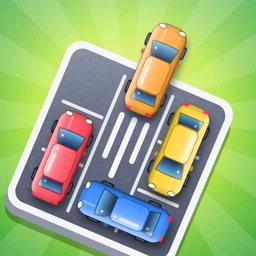
How to play
Each car has a white arrow (a chevron) painted on its roof. That arrow is the only direction the car can travel. Tap a car and one of three things happens:
- Clear lane: nothing stands between the car and the edge of the lot, so it drives out onto the ring road, turns, and disappears. You get a small "+1" for every car that leaves.
- Partly clear lane: there is empty space in front of the car but another car further along. Your car rolls forward, bumps the blocker with a "HONK!", and stays in its new spot.
- Nose to nose: the car is already touching the car ahead. It nudges forward, honks, and settles back. Nothing changes.
You win when the lot is empty. There is no timer and no move limit. You can't lose outright, but you can jam the lot: if you roll cars into positions where no sequence of taps can free everyone, a banner appears saying "Jammed! Tap UNDO or HINT".
Three buttons help. Undo takes back your last move, including a car that already left. Hint highlights a good car to tap and points an arrow in its direction; if you are already jammed, it first quietly rewinds to the last position that can still be solved. Skip moves you on to the next level if one lot is driving you up the wall.
Beginner strategy
The first few levels are warm-ups, but they teach the habit that matters for the rest of the game: look for exits before you look for anything else.
- Drive out every free car first. A car with an open lane can leave right now, and leaving never hurts you. It only frees space. Scan every car, follow its arrow to the edge, and tap all the ones that have a clear run.
- Repeat the scan. Each car that leaves can open a lane for another. Keep sweeping the lot until nothing else can exit.
- Only then think about rolling. When no car can leave, you have to roll one forward into the gap in front of it. This is the only kind of move that can go wrong, so treat it with care.
Around level 3 the game shows you this idea directly: sometimes no car has a way out, and the only progress is to roll a car forward so that it stops blocking someone else's lane.
Advanced techniques
Ask what a roll uncovers, and what it covers
A rolling car does two things at once. It vacates the cells behind it, which might be sitting across another car's lane, and it moves into new cells further ahead, which might now sit across a different car's lane. Before you roll, check both. A good roll frees at least one car to drive out and lands somewhere harmless. A bad roll frees nothing and parks in the one lane you needed.
The longest roll is often the wrong one
When you are stuck, it is tempting to tap the car with the most empty road in front of it, because it looks like the biggest move. Our levels are built so that this "obvious" roll is frequently a trap. A car sliding three spaces can end up blocking two lanes. A short one-space roll that clears a single key lane is usually stronger.
Work backward from the hardest car
Find the car that looks most buried and follow its arrow. Note every car sitting in its lane. Each of those has to leave (or roll out of the way) first. Then follow their arrows. This builds a short chain of dependencies, and the car at the end of the chain is where you should start.
Treat trucks as walls
Three-cell trucks start appearing around level 6. Because they cover more ground, a truck crossing several lanes is often the single biggest blocker on the board. Getting a truck out early frees a lot at once. Rolling one carelessly does the opposite, since a truck that stops in the wrong spot can seal off three lanes.
Common mistakes
- Rolling before exiting. If any car can leave, let it leave first. Rolling while free exits are still available just adds risk.
- Tapping nose-to-nose cars over and over. If a car is already touching its blocker, tapping it does nothing. The honk is the game telling you to look elsewhere.
- Ignoring the arrow. A car pointing toward the middle of the lot will never drive out the near edge, no matter how close that edge looks.
- Playing on after a jam. Once the jam banner appears, no amount of tapping will fix it. Use undo (or hint, which rewinds for you) right away.
What changes in later levels
The lot grows steadily. It starts as a 4 by 4 grid with two cars, reaches 6 by 7 with around ten cars by level 10, and keeps expanding to 7 by 9 and then 8 by 10 in later stages, with more than twenty vehicles. The number of forced rolls goes up too, from one in the early levels to three or four later on. That means longer chains where several cars have to shuffle forward in the right order before the exits open up.
Difficulty follows a sawtooth rather than a straight line. Every tenth level is a tougher "boss" lot with extra cars and an extra required roll, and the level right after it is deliberately easier so you get a breather.
FAQ
Can a car drive backward?
No. In our version every car moves only in the direction of the arrow on its roof. If you want a car out of the other end, you have to clear its path forward or leave it until last.
Is every level solvable?
Yes. Each lot is checked by a solver before it is used, so there is always at least one order of taps that empties it. If you are stuck, you have either missed a move or made a roll that jammed the lot.
Does undo cost anything?
No. Undo is free and unlimited, and it can bring back cars that have already left. Use it to experiment with a risky roll, see what it opens, and take it back if it goes badly.
Why did the hint move my cars?
If the lot is already jammed, the hint first steps back through your moves to the last position that can still be solved, then shows you the next good car from there.