 Happy Life Games
Bus Jam Guide: How to Board Every Passenger Without Running Out of Seats
Bus Jam is a color-matching puzzle set at a busy bus stop. A plaza full of little passengers waits below the road, buses arrive one at a time, and each bus will only take passengers of its own color. You decide who walks to the stop and when. Send the right person and they hop straight on. Send the wrong one and they sit on a bench to wait, and there are only a few benches.
The fun is in the planning. Every level is built so that there is exactly enough bench space for a careful player, and the order that looks natural at first glance usually runs you out of seats a few buses later.
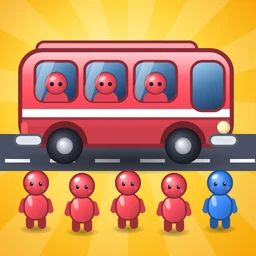
How to play
The plaza is a grid of passengers, and the road runs along the top of it. A passenger can only leave if they have a free path to the top edge, walking up, down, left or right through empty squares. Passengers in the top row can always leave. Those with an open route stand bright and bounce a little; passengers who are boxed in look flatter and can't be tapped.
- Tap a passenger with a free path. They walk out of the plaza toward the stop.
- Matching color: if they match the bus parked at the stop, they board it. Each bus has three seats, and when it is full it honks and drives off. The next bus pulls in.
- Different color: they sit on one of the waiting benches between the road and the plaza.
- Benches empty themselves: when a new bus arrives, any waiting passengers of its color get up from the benches and board automatically, up to three of them. If that fills the bus, it leaves and the next one does the same.
You win when every bus has left full. You lose when the benches are full and none of the passengers you can reach match the current bus. At that point no legal tap is left and the level ends with "No space!".
The game warns you as you get close. When only one bench is left, the empty seat glows red and "Last seat!" appears. If you tap a non-matching passenger with every bench taken, the benches flash and the tap is refused.
You also have Undo (step back one tap, as long as the level hasn't ended), Hint (circles the next passenger to send) and Skip.
Beginner strategy
Look at the buses before you look at the passengers. The bus at the stop is large, and the next two in line wait smaller on the left side of the road, with a "+" counter showing how many more are coming. That queue is your plan.
- Board every matching passenger you can reach. Sending a matching passenger never costs a bench and always frees a square in the plaza, so it is never a bad move.
- If no one matches, choose the bench-sitter carefully. Prefer a passenger whose color is coming soon, ideally the very next bus. They will leave the bench almost immediately.
- Prefer passengers who unlock others. If two choices are equal, pick the one whose departure opens a path for someone in a color you need.
Advanced techniques
Count colors against the queue
Every color appears in multiples of three, because every bus has three seats. If two red buses are coming, there are six red passengers somewhere in the plaza. Before you bench anyone, count how many of the current bus color you can actually reach. If the answer is fewer than the seats left, you know you'll have to dig, and you need to keep benches free for that dig.
Dig toward the color you need next
When the current bus's passengers are buried, look at what is between them and the top. Those blockers will have to go to the benches. Choose the digging route that benches the fewest passengers, or benches passengers whose buses come soon.
Let arriving buses empty the benches
A clever sequence often fills a bus so that the next one arrives, takes two or three waiters off the benches, and frees space for the next round of digging. Plan for these chain reactions. Benching three passengers of the next bus's color is fine, since they'll all leave together the moment it pulls in.
Don't bench a color you won't see for a long time
A passenger whose bus is five places back will sit on a bench for most of the level. Each one like that permanently shrinks your working space. If you have to bench someone, pick the color that leaves soonest.
Common mistakes
- Tapping the closest passenger by habit. The levels are generated so that simply sending whoever is nearest, or boarding matches nearest-first, eventually jams. Read the queue first.
- Using the last bench casually. When "Last seat!" appears, your next non-matching tap must be one that leads to a match right away. Otherwise you're one tap from losing.
- Forgetting sideways paths. Passengers can walk around corners. A passenger deep in the plaza may already have a route to the top through an empty square next to them.
- Waiting too long to undo. Undo works only while the level is still running. If you sense a jam coming, back up before the last bench fills.
What changes in later levels
The opening levels have one or two buses and a tiny plaza. From level 3 you'll meet four buses and three colors, and the count keeps rising, reaching ten or more buses and up to six colors in later stages. From level 6, trees appear in the plaza. They never move and nobody can walk through them, so they create dead ends and force longer routes to the top.
The number of benches varies with the level. It is set to the smallest number that still allows a solution, usually three or four, and up to five in later levels. Every tenth level is a bigger "peak" with two extra buses and an extra tree, followed by an easier level to recover.
FAQ
Why can't I tap some passengers?
They have no route to the top. Every square around them leads only to other passengers or trees. Clear a neighbor first and they'll light up.
Do waiting passengers board automatically?
Yes. When a bus of their color arrives, up to three of them walk from the benches to the bus on their own.
Is every level solvable?
Yes. Each level is checked by a solver with the exact number of benches it gives you. If the hint can't find a move, it means your current position is jammed and you should undo.
What is the best first move?
If anyone matching the first bus can walk out, send them. If not, bench a passenger whose color is next in the queue.