 Happy Life Games
Block Blast Puzzle Guide: Clearing Gems With a Fixed Set of Pieces
Most block games are about survival: keep placing random pieces and clear lines for as long as you can. Our Block Blast is different. Every level is a hand-checked puzzle with a fixed, small set of pieces and a clear goal: blast every gem on the board. Because you only get the pieces you're dealt, there's no room for filler moves. Each piece has a job, and the most obvious place to put it is often a trap.
That makes Block Blast feel closer to a logic puzzle than an arcade game. This guide covers the rules, a way of thinking that cracks most levels, and the ice and stone blocks you'll meet later.
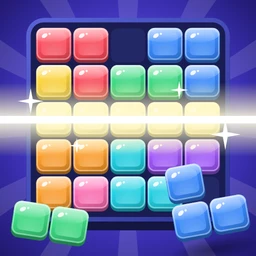
Rules and controls
- The board is an 8 by 8 grid, already partly filled with blocks. Some of those blocks carry a gem.
- Your pieces sit in a tray below the board. Drag a piece onto the board and let go to place it. The piece floats above your finger while you drag so you can see where it lands.
- Pieces never rotate. An L shape facing left will always face left.
- When a row or column is completely full, it blasts away. Any gem on a cleared line is collected. The counter at the top tracks how many gems you've collected.
- You win when every gem is gone. You lose if you run out of pieces with gems still on the board, or if none of your remaining pieces fit anywhere.
Pieces are dealt in rounds of up to three. You must place all the pieces in a round before the next round arrives. On multi-round levels, the next round is shown under the tray so you can plan ahead, and the game labels the last round.
Undo takes back your last placement and can be used as often as you like. Hint shows a placement from a winning line; if your current position can no longer be won, it first undoes back to a solvable point. Skip lets you move on.
Beginner strategy
The habit that matters most is to look at all the pieces before you place the first one. Then work backward from the gems.
- Find each gem's lines. Every gem sits in one row and one column. Clearing either one collects it.
- Count the gaps. For each of those lines, count the empty cells and note their shape. A row with two empty cells side by side needs a horizontal domino, or the matching part of a bigger piece.
- Match pieces to gaps. Look for a piece in your tray that fills one of those gaps exactly. A line that one of your pieces can finish is a line you can count on.
- Look for double duty. The best placements finish a row and a column at the same time, or finish one line while also filling cells another line needs.
Once you've matched a piece to every gem, place them in an order that doesn't block the others. Usually that means placing the piece with the fewest possible spots first.
Advanced techniques
Why the obvious spot is a trap
From level 3 onward, the levels are designed so that grabbing the first gem you can reach, or dropping a piece into the snuggest-looking hole, tends to leave you stuck. A typical example: a T piece fits neatly into a notch and completes a row with one gem. That feels great, but the same T was the only piece that could finish the column holding two other gems. Before you take a quick win, ask whether that piece is needed somewhere else.
Clearing changes the board
A blast empties cells, and empty cells are space your later pieces need to fill. Sometimes it's better to complete a line last, after other pieces have used the blocks in it as support. And sometimes clearing a line early is what makes room for a large piece. Before each placement, picture the board after the blast, not just before it.
Ice blocks
Ice looks like a frosted block. When a line containing ice is cleared, the ice cracks into a normal block instead of vanishing. That means the cell is still filled afterward. This can be helpful, because that block now counts toward the next line through it, but it also means you can't count on that cell becoming free.
Stones
Stones never break. They do count as filled cells, though, so a row with a stone in it still blasts when the other seven cells are full. Everything else in that row clears, and the stone stays put. Treat stones as permanent parts of the board's shape and build your lines around them.
Planning across rounds
On multi-round levels, check the "next" preview before you finish the current round. If the next round has a long straight piece, keep a straight gap open for it. If it has a big square, don't clutter the open area the square would need. A placement that uses up the only space the next round can fit into is the classic way to see "No space left!".
Using undo well
When you leave the winning path and the position becomes a dead end, the game shows a gentle "Stuck?" prompt. Undo is free, so treat it as part of solving: place a piece, look at what it leaves, and take it back if it ruins a line you need.
Common mistakes
- Placing pieces one at a time without a plan. With only three pieces, every one matters.
- Forgetting pieces don't rotate. Check the exact orientation before you drag.
- Expecting ice to disappear. It turns into a block, so the line won't be empty afterward.
- Leaving the awkward piece for last. Big or oddly shaped pieces usually have the fewest legal spots. Place them early while there's still room.
What changes in later levels
Level 1 is a single piece and a single line, and level 2 adds a second piece. Level 3 brings full rounds of three pieces and the first traps. Ice appears from level 5, and level 7 reminds you that pieces never rotate. Larger shapes such as long bars, three-by-two blocks and zigzags join the tray as you advance.
Level 11 introduces two rounds of pieces with a preview, and level 13 introduces stones. After that, levels mix ice, stones and one or two rounds, with busier boards and fewer winning lines. Every tenth level is a peak with an extra gem and very few ways to win, and the level after it is a relaxed one.
FAQ
Is every level solvable?
Yes. Each level was checked by a solver that explored every order and position, so at least one winning line always exists with the pieces you're given.
Do I have to place every piece?
No. The level ends with a win the moment the last gem is collected, even if pieces are left over.
Can I rotate or flip a piece?
No. Pieces always keep the orientation shown in the tray.
What does a combo do?
Clearing lines on several placements in a row shows a combo counter. It's a nice bonus to see, but the goal is always the gems.