 Happy Life Games
Cake Slice Guide: How to Cut Equal Pieces and Split the Cherries
Anyone who's cut a birthday cake knows the problem. Halves are easy, quarters are fine, but thirds always end with someone eyeing a bigger slice. Cake Slice turns that small everyday challenge into a puzzle. You swipe straight knife cuts across cakes, pizzas, watermelons, cheese wheels, cookies and loaves, and the game measures every piece to the percent.
Later levels add a second kind of challenge: cherries, olives and candies scattered on top. Now you have to split the food so that every piece gets exactly one topping, using only a few cuts, without slicing through anything you shouldn't.
How cutting works
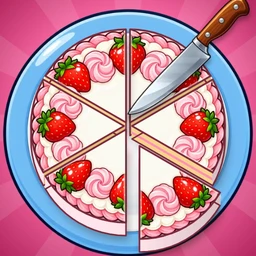
Swipe across the food in a straight line. A very short swipe is ignored, so make it a confident stroke. The important thing to understand is that each cut is a full straight line. It continues across the whole food and splits every piece it crosses, not just the piece under your finger. After each cut the pieces slide slightly apart so you can see them.
A swipe that doesn't actually cut anything shows "Missed!" and doesn't count. Undo takes back the last cut, and you can use it as often as you like.
The three kinds of level
Equal pieces and fractions
The banner says something like "Cut it in half!", "Cut into 4 equal pieces" or "Cut off exactly 1/3". A chip below it shows the accuracy you need. That starts at 70% and rises toward 90% in later levels.
The level is judged the moment you have the target number of pieces. If you make more pieces than asked, the level is lost with "Too many pieces!". If your accuracy is below the target, the level is lost with "Uneven!". Accuracy is based on your worst piece. If you halve a cake 55% / 45%, each piece is 10% away from the 50% target, so your accuracy is 90%. Better accuracy earns more stars.
After each cut, every piece shows its share as a percentage, and the label turns green when that piece is close to a target. Watch those numbers. They tell you exactly how far off a cut was.
One topping in every piece
These levels show "One cherry in every piece" (or olive, or candy) and give you a fixed number of cuts. Piece sizes don't matter here. What matters is that each piece ends up with exactly one topping. The knife can't pass through a topping. If a cut would slice one, it's blocked with a message like "Don't cut the cherry!" and nothing is cut. From level 7, candles appear too. They aren't toppings to share out, just obstacles your cuts must avoid.
Fair shares
The hardest mix: "4 equal pieces, one olive each". The pieces must be equal (with an accuracy target) and each must hold one topping. You get exactly half as many cuts as pieces, which on a round food means every cut has to go straight through the center.
Beginner strategy
- Halves on a round food: cut straight through the center. The center is the only thing that matters; the angle is up to you.
- Quarters: two cuts through the center at right angles. For six equal wedges, three cuts through the center, each turned 60 degrees from the last.
- Rectangles and loaves: halves and quarters come from cuts through the middle, parallel to the edges.
- Read the percentages after the first cut. If one half shows 53%, the next cut won't fix it, so undo and recut a little closer to the bigger side.
Advanced techniques
Odd numbers need parallel cuts
Here's where most players get caught. Three equal pieces from a round cake cannot come from two cuts that cross inside the food, because that always makes four pieces, and four pieces on a "3 pieces" level is an instant loss. Instead, make two parallel cuts, or at least two that don't meet inside the food. On a circle the middle strip needs to be noticeably narrower than a third of the width, because the middle of a circle is where it's widest. Five equal pieces works the same way, with four parallel cuts.
Cutting off a fraction
For "Cut off exactly 1/3" or "1/4" you make one cut that leaves a smaller piece of the right size. On a circle, the cut for a quarter sits a little less than halfway from the center to the edge. Cutting exactly halfway out gives a piece of only about a fifth. Make your first guess, read the percentage label, and use undo to adjust.
Counting pieces against cuts
On topping levels, check whether the numbers even allow a lazy approach. One straight cut makes 2 pieces. Two cuts make at most 4, and only if they cross inside the food. Three cuts make at most 7, and only if each pair crosses inside the food at three different points. So a level asking for 7 pieces in 3 cuts leaves you no slack. The three lines must form a small triangle somewhere on the food, never all passing through a single point.
Separate the closest pair first
When two toppings sit close together, the only line that splits them may be tightly constrained, passing between them without touching either one or a candle. Find that line first, since it's the least flexible, then plan the remaining cuts around it.
Common mistakes
- Crossing cuts on an odd-number level. Crossing lines add extra pieces.
- Forgetting the cut goes all the way across. A cut meant for one half also slices the other half if the line crosses it.
- Leaving a piece empty. On topping levels, if a cut creates a piece with no topping, the game tells you ("This piece has no cherry!") and you'll need to undo. Running out of cuts shows "Out of cuts!". Neither one ends the level, so undo or take a hint.
What changes in later levels
The first twelve levels introduce one idea at a time: halves, quarters, the first cherry level at 3, fair shares at 5, thirds of a loaf at 6, candles at 7 and five cherries in three cuts at 12. After that, levels mix all three kinds. Heart cakes and star cookies join from level 15, fractions like 2/5 appear, accuracy targets tighten, and topping levels push toward 6 or 7 pieces with three cuts and more candles. Every tenth level is a tougher peak.
FAQ
What does the hint do?
It shows dashed lines for a complete cutting plan, numbered when there's more than one cut. On topping levels, if you've already cut, the hint first rewinds to the whole food for free.
How are stars awarded?
On equal-piece levels, by accuracy. On topping levels, by how many times you used undo: none gives three stars.
What should I try next?
For more geometry-flavored thinking, try Paper Fold or Brain Teaser, and see How to Solve Logic Puzzles for general solving habits.