 Happy Life Games
Penguin Slide Guide: How to Solve Ice Sliding Puzzles
Penguin Slide is built on one of the oldest ideas in puzzle games: ice is slippery. Swipe in a direction and your penguin slides until something stops it. You can't stop halfway, so a fish that sits right in front of you may still be hard to reach. The puzzle is figuring out which walls, rocks and snow piles you can use as brakes.
Collect every fish on the board and, on later levels, slide the penguin back into its igloo. It looks simple, and the early levels are, but before long you'll be planning four or five swipes ahead.
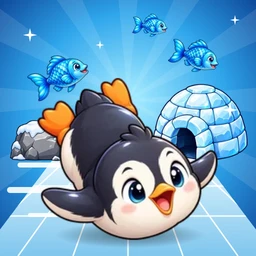
Rules and controls
- Swipe anywhere on the screen, up, down, left or right, to send the penguin sliding that way.
- The penguin keeps sliding until the next cell is blocked: a rock, the edge of the board, or another obstacle. It stops on the last free cell.
- Fish are collected on the way. Sliding over a fish picks it up without stopping you.
- If nothing can move in that direction, the penguin wobbles and nothing changes.
- Win by collecting every fish. From level 6, you also need to get the penguin into its igloo after the fish are gone.
Undo takes back your last swipe, restart resets the board, the hint shows an arrow for the next swipe, and skip moves you on. You can't lose a level, but you can trap yourself in a position the puzzle can't be solved from. When that happens the game says "Stuck? Undo or hint". Ask for a hint from a stuck position and the game rewinds you to the last position that can still be solved.
Reading the board
Everything in this game comes down to one question: where will this swipe stop? Before swiping, look along the row or column in that direction and find the first blocker. The penguin ends up on the cell just before it. A few things count as blockers:
- Rocks stop you on the cell in front of them.
- The board edge stops you against the wall.
- Snow piles (from level 4) stop you on the snow. They're the only way to stop in open space.
- The igloo stays closed and acts like a rock until you've collected every fish. Then it opens, and sliding into it ends the level.
Beginner strategy
- Find each fish's stoppers. For each fish, ask which swipe would slide through it. That means the penguin has to be in the same row or column, with nothing blocking in between.
- Work out the landing spots. Picture the penguin's possible stopping points as a small map. From the start you usually have only two or three places you can reach in one swipe.
- Plan two swipes at a time. Pick a fish, then ask where you need to be to slide through it, and how you get to that spot.
- Don't grab the nearest fish first. Level 3 introduces this idea: the closest fish can lead you into a corner you can't get back out of.
Advanced techniques
Think in stopping points, not cells
The penguin can only ever rest on a limited set of cells: those next to rocks, against walls, on snow, or beside a closed igloo. Spotting that set turns a big board into a small network of places connected by swipes. Solving it means finding a walk through that network that passes over every fish.
Work backward from the igloo
Once there's an igloo, your final swipe has to slide you into it. Look at the igloo's row and column and find which stopping points line up with it with a clear path. That tells you where your last fish needs to leave you. Then plan the fish order so you end up there.
Use a closed igloo as a wall
Before the fish are collected, the igloo blocks you like a rock. That can be useful: a slide that stops against the closed igloo is sometimes the only way to reach a fish. Just remember it opens the moment you pick up the last fish, so it stops working as a wall after that.
Undo is part of the plan
There's no penalty for undoing, so test ideas freely. Swipe, look at where you ended up, and undo if it doesn't help. It's often faster than calculating every move in your head.
Common mistakes
- Expecting to stop on a fish. You slide right over fish. They're collected, but they won't slow you down.
- Burning thin ice too early. Once you slide off a thin ice cell it cracks into water, and water blocks you forever. Cross it on the trip where you need it.
- Ignoring snow. Snow piles don't just stop you, they also stop you in places you might not want. Check whether a slide passes onto snow before it reaches the cell you were aiming for.
- Wandering without a goal. Random swipes in a closed room can loop forever. Pick a target fish and plan the route there.
What changes in later levels
The board starts at five by six with a single fish and grows to seven by nine, with up to five or six fish. New pieces are introduced one at a time:
- Level 4: snow piles, which stop you wherever they sit.
- Level 6: the igloo. Collect every fish, then go home.
- Level 8: thin ice. You can slide across it, but it cracks as you leave. The hole left behind blocks you from then on, just like a rock. Thin ice can be used deliberately to create a new stopper.
- Level 21: twin penguins. On some later levels, two penguins share the board and every swipe moves both. They block each other, so one penguin can act as the stopper for the other. Those levels don't have an igloo, so the goal is simply collecting all the fish.
The best solution usually grows longer as you go, from a single swipe at the start to nine or ten on the toughest boards. Every tenth level is a harder peak, and the one after it is easier.
FAQ
Can the penguin fall off the edge?
No. The edge of the board works like a wall, and the penguin stops against it.
Why won't the penguin go into the igloo?
There's still a fish left. The igloo opens only once every fish is collected. Until then it blocks you.
What happens if I make a move that can't be solved from?
The game tells you you're stuck. Use undo, or tap the hint and it rewinds you to the last solvable position and points the way forward.
How do twin penguins move?
Both slide in the same direction at once. Each one stops at its own blocker, and a penguin counts as a blocker for the other.