 Happy Life Games
Word Search Strategy: How to Spot Hidden Words Faster
Word search is one of the most familiar puzzles there is: a grid of letters, a list of words, and the quiet satisfaction of circling each one. Every word is hidden in a straight line, so all you have to do is look. In practice, your eyes skip over words that are right in front of them, and that is exactly what makes a good search fun.
Each level in our Word Search has a theme, such as Animals, Space or Desserts, shown at the top of the board. The early grids are small and friendly, while later ones hide words in every direction and add a few tricks of their own. This guide explains how the game works and how to scan a grid like an experienced solver.
How to play
- Check the word list to see what you are looking for.
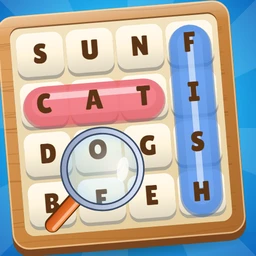
- Find a word in the grid and drag your finger in a straight line from its first letter to its last. The selection snaps to the nearest of the eight directions: across, up and down, or diagonal.
- Release. If the letters spell a word on the list, it is circled in color and crossed off.
You can drag from either end of a word, so a backward word can be selected forward and vice versa. Find every word on the list to complete the level. There is no timer and no way to lose, but a level finished without any wrong selections earns a "Perfect!" instead of a "Great!".
Each word appears exactly once in the grid, and the puzzles are cleaned up so that no list word shows up twice by accident. If you think you have found a word in two places, one of them is a near miss.
Beginner strategy
Hunt for the rare letters
Common letters like E, A and T are everywhere, so searching for them is slow. Pick a word with an unusual letter, such as the Z in ZEBRA or the X in a word like FOX, and scan for that letter instead. There are usually only one or two of them, so the word is quick to confirm.
Look for letter pairs, not single letters
Instead of finding every B and checking around it, look for a distinctive pair like "BR" or "CK" from the word you want. Pairs are much rarer than single letters, and your eyes pick them out quickly once you know what you are looking for.
Sweep in one direction at a time
Scan the grid row by row for horizontal words, then column by column for vertical ones, then along the diagonals. Trying to check all directions at once from every letter is tiring and easy to get wrong. A systematic sweep covers the board completely.
Start with the long words
Long words cover more of the grid, so they are easier to spot. Once they are circled, the remaining area to search for short words shrinks.
Advanced techniques
Read backward on purpose
From level 11, some words run backward. Our brains are trained to read left to right, so a backward word can sit in plain sight without being noticed. Flip the word in your head (TIGER becomes REGIT) and scan for that string. It feels strange at first but becomes natural quickly.
Watch for fake starts
From level 4, the grid contains decoys: the first few letters of a list word, spelled in a line, followed by a wrong letter. If you trace the start of a word and the next letter does not match, do not keep extending the selection. That is a decoy, and the real word is somewhere else. If you release on one, the game shows "So close! Fake start." The lesson is to read the whole word before you drag.
Use shared letters
From level 8, some words cross each other and share a letter. When you find one word, glance across its letters to see if another list word passes through it. Crossing points are a common place for two words to hide.
Solve mystery words with the theme
Starting at level 5, some list entries are mystery words. Instead of the full word, the list shows the first letter followed by question marks, one for each remaining letter. So "S????" is a five-letter word starting with S. Use the theme to guess candidates: if the theme is Space and the clue is S?????, SATURN is a good guess. Then search for it. When you find it, the word is revealed.
Common mistakes
- Dragging too soon. Releasing on a fake start counts as a miss. Check the full word before you lift your finger.
- Forgetting directions. If a word does not appear horizontally or vertically, check the diagonals and the backward directions before deciding it is not there.
- Only searching from the first letter. The last letter of a word can be just as distinctive. A word ending in Y or K might be easier to locate from its end.
- Ignoring the theme. On mystery levels, the theme is your best clue.
What changes in later levels
The directions open up step by step. Levels 1 and 2 only use words that read left to right. Level 3 adds words going down, level 6 adds diagonals, level 11 adds backward words, level 12 adds diagonals going up, and level 21 adds words that read upward. From level 31, words can run in all eight directions. The grid grows from 4x4 at the start to 9 columns by 10 rows, and later puzzles hide up to ten words. Every tenth level is a bigger one with an extra word and two mystery words, and the level after it is a lighter breather. From level 41, mystery words become blind: the list shows only question marks, with no first letter, so you need the theme and the word length to work it out.
FAQ
Can words go backward or diagonally?
Yes, in later levels. The game introduces each new direction with a short message so you know when to start looking for it.
What does the hint do?
It highlights the first letter of a word that has not been found, and a hand shows the direction to drag. If there is an unsolved mystery word, the hint picks that one first and reveals its full name in the list.
Why did my selection not count?
Either the letters do not spell a word on the list, or you stopped one letter short or one letter too far. Check that your line starts and ends on the right letters.
Can I skip a level?
Yes. If a grid has you stuck, the skip button moves you on to the next level.